
Have you ever wondered what is actually inside the Revit models your consultants, architects, engineers, or BIM teams are working on?
For many project owners, estimators, project managers, and stakeholders, the answer is often hidden behind technical barriers. Accessing a Revit model traditionally requires specialized software, expensive licenses, powerful hardware, and the knowledge to navigate a complex BIM environment.
But what if you could access all that information without Revit?
That's exactly why I find VIM so interesting.
BIM Data Without the BIM Complexity
Our friends at VIM have developed one of the most powerful tools I've seen for viewing, querying, and extracting information from Revit models.
Instead of relying on someone else to generate reports or export schedules, users can interact directly with the model and access the information they need.
Whether you're:
- A project owner looking for building information
- An estimator validating quantities
- A project manager tracking scope
- A stakeholder reviewing project progress
- A facilities manager preparing for operations
VIM allows you to explore the model without needing Revit expertise or specialized hardware.
More Than a Model Viewer
What makes the platform particularly exciting is that it goes beyond simple visualization.
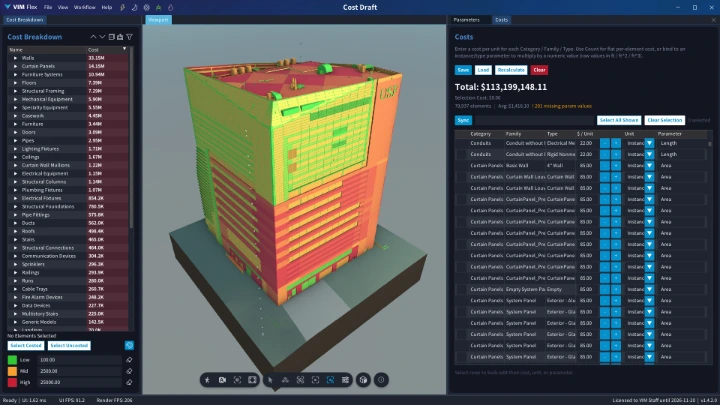
Users can search, filter, analyze, and extract valuable project information directly from the model.
Need quantities?
Need room information?
Need asset data?
Need to understand what's included in a particular scope?
The information is available through an intuitive interface that makes BIM data accessible to everyone involved in the project.
Built on Power BI, Supercharged for Construction
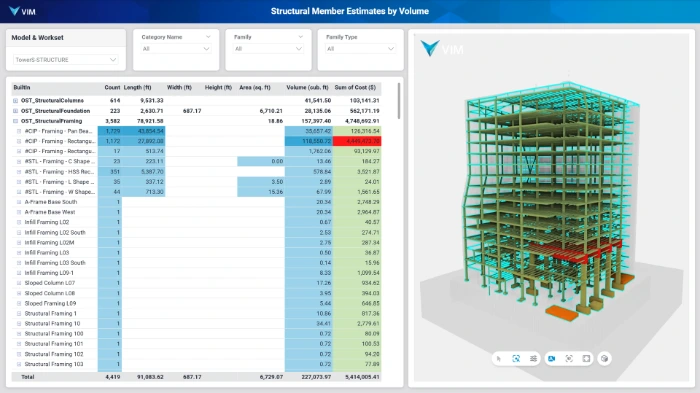
Another aspect that makes VIM particularly compelling is its seamless integration with Microsoft Power BI.
Many organizations already use Power BI for dashboards, reporting, and executive decision-making. VIM extends those capabilities by connecting BIM data directly to a familiar business intelligence environment.
This means project stakeholders can leverage powerful reporting tools without having to build complex data pipelines or manually export information from Revit.
With VIM, teams can:
Create interactive project dashboards
Monitor key performance indicators (KPIs)
Track quantities, assets, and project metrics
Analyze model data across multiple projects
Generate custom reports for different stakeholders
Leverage existing Power BI templates and reporting workflows
What I find particularly valuable is that VIM doesn't force users into a proprietary reporting ecosystem. Instead, it enhances and simplifies access to one of the most widely adopted business intelligence platforms in the world.
For project owners, executives, and project managers, this means BIM information can be consumed in the same way they review financial, operational, and organizational data, through intuitive dashboards and visual reports.
The result is a more connected approach to decision-making, where model data becomes part of everyday business intelligence rather than remaining locked inside a technical BIM environment.
Interacting with Models Like AI
One of the most fascinating aspects of the platform is how naturally users can interact with model information.
Instead of manually navigating through thousands of model elements, users can ask questions and receive targeted answers from the model data.
This dramatically reduces the learning curve and makes BIM information available to people who may never open Revit.
As artificial intelligence continues to transform the construction industry, tools like VIM demonstrate how BIM data can become more accessible, searchable, and actionable.
Why This Matters
For years, BIM has promised better information management.
The challenge has never been creating the information. Revit models already contain an incredible amount of valuable data.
The challenge has been making that information accessible to the people who need it.
VIM helps bridge that gap.
By removing software barriers and simplifying access to model information, project teams can make better decisions faster, reduce dependency on specialized users, and unlock more value from the BIM models they already have.
Final Thoughts
What excites me most about VIM is not just the technology.
It's the democratization of BIM information.
The ability for owners, project managers, estimators, and stakeholders to access model data directly represents a significant shift in how construction teams can leverage digital information.
The easier it becomes to access information, the more valuable our models become.
And that's a future I'm excited to see.
At Revit Hero, we're always looking for technologies that help our clients extract more value from their BIM investments. VIM is certainly one of the platforms worth paying attention to.
The future of BIM isn't just about creating better models. It's about making information accessible, actionable, and available to everyone involved in a project. Tools like VIM, combined with the reporting power of Power BI, are helping make that future a reality.
Check them out here.