Have you ever wondered what is actually inside the Revit models your architects, engineers, consultants, contractors or BIM teams are working on?
Not just what the building looks like.
What information is actually there?
How many doors are in the model? Which equipment belongs to a particular room? What changed between model versions? Which elements are missing required information? What quantities can be extracted? What assets will eventually need to be maintained?
A Revit model can contain thousands, sometimes millions, of pieces of project information.
The problem is that most of the people who could benefit from that information never open Revit.
That includes owners, general contractors, project managers, estimators, municipal staff, executives, facility managers and other project stakeholders.
And that exposes one of the biggest contradictions in BIM:
We spend enormous amounts of time and money creating information that many of the people making project decisions cannot easily access.
That is why tools such as VIM are so interesting.
The Real Problem Is Not Creating BIM Data. It Is Accessing It.
Revit is an incredibly capable authoring platform.
Architects, engineers, contractors and BIM professionals use it to create coordinated models containing geometry and information about walls, doors, rooms, equipment, systems, materials, quantities, locations, classifications, parameters and much more.
But Revit was primarily built for the people creating and managing that information.
An owner should not need to become a Revit expert just to understand what equipment is in a building.
A project manager should not need to ask a modeller to create a schedule every time they need information.
An estimator should not have to navigate an unfamiliar authoring environment simply to investigate quantities.
And an executive should not need a powerful modelling workstation just to understand what is happening in a project.
The model already contains valuable information.
The challenge is making that information available in a way the rest of the organization can actually use.
A Revit Model Is More Than a 3D Building
For people outside BIM, it is easy to think of a Revit model as a sophisticated 3D drawing.
It is much more than that.
Every element can potentially carry information.
A door might contain:
Type and dimensions
Fire rating
Manufacturer
Material
Hardware information
Room association
Classification
Cost information
Asset identifiers
Mechanical equipment can contain capacity, manufacturer information, model numbers, electrical requirements, installation information and maintenance data.
Rooms can carry names, numbers, areas, departments and occupancy information.
Walls, floors and ceilings can contain types, assemblies, materials, areas and quantities.
The BIM model therefore becomes a database that happens to have geometry.
That distinction matters.
Once you stop thinking about BIM only as a way to create drawings and start thinking about it as a structured source of project information, entirely different opportunities emerge.
So, What Is VIM?
VIM provides tools for converting BIM information into a format that can be viewed, analyzed, compared and connected to other data workflows.
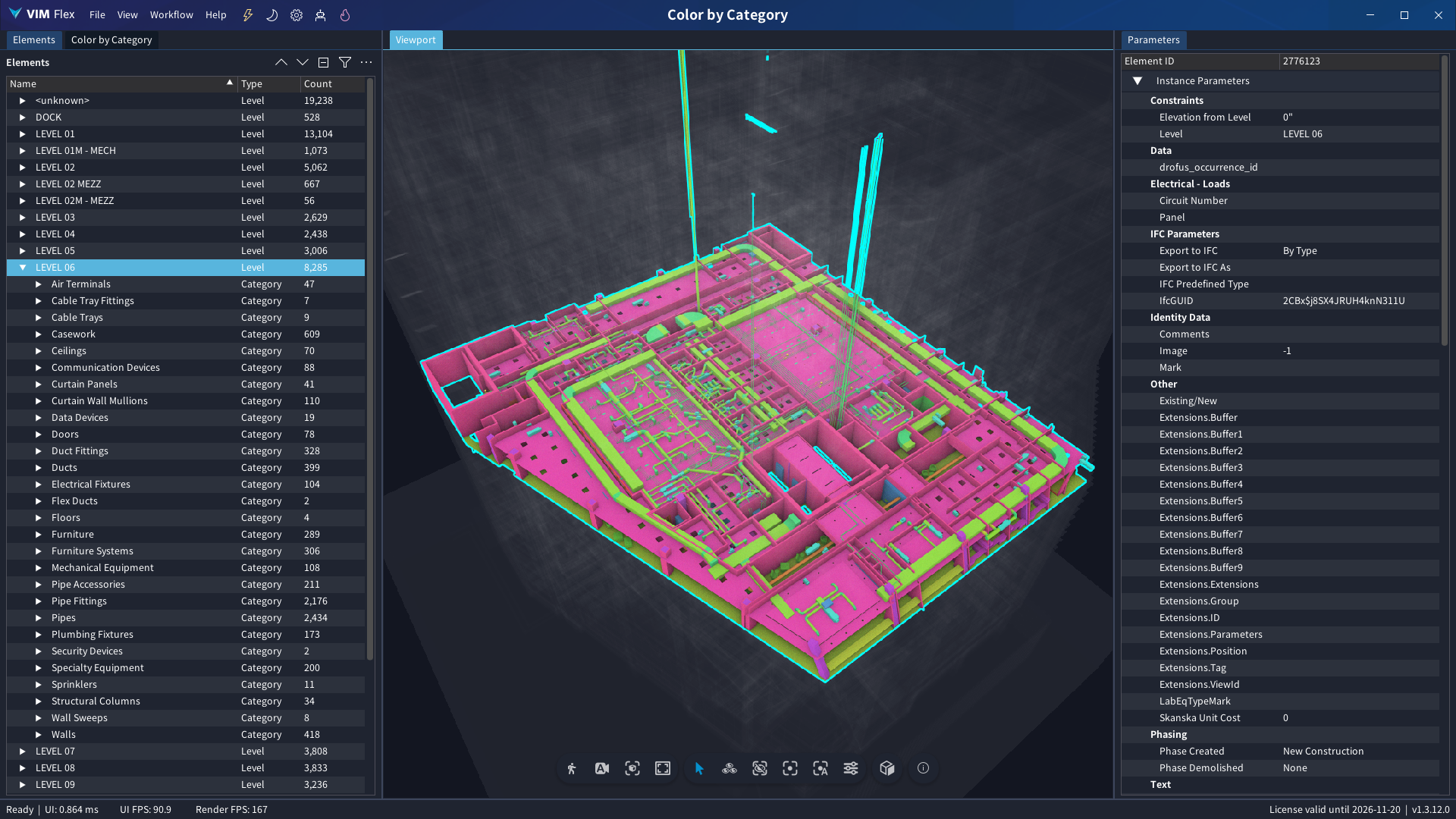
VIM Flex can work with model information exported from Revit, Navisworks and IFC. Users can navigate the 3D model, inspect information, generate element counts, compare revisions and perform model-analysis workflows without working directly inside the original authoring application.
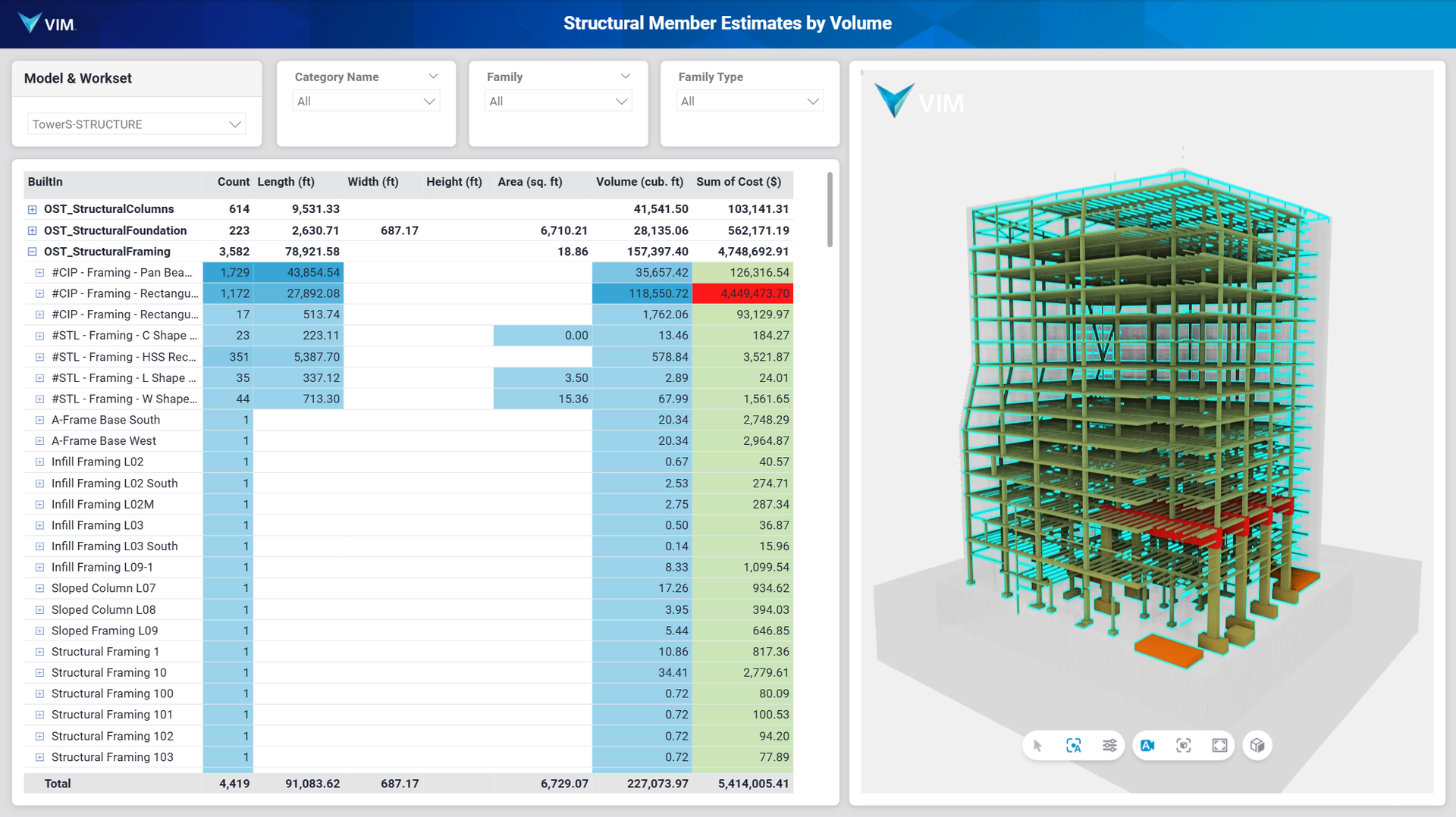
VIM Enterprise takes the concept further by automating BIM data processing and connecting interactive 3D model information with Microsoft Power BI.
This changes the conversation from:
"Can somebody from BIM send me that information?"
to:
"Can I access and analyze that information myself?"
That is an important shift.
More Than a Model Viewer
There are already many ways to view a 3D model.
Viewing is useful, but simply orbiting around a building is not necessarily what creates business value.
The real opportunity is being able to connect what you see to the information behind it.
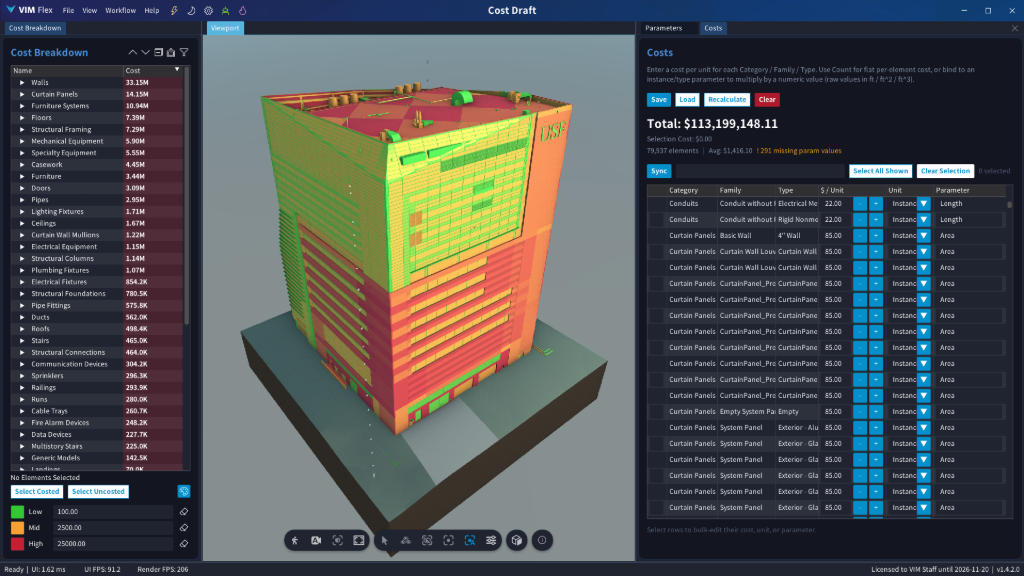
VIM Flex allows users to inspect model elements and their parameters, isolate components and analyze the information contained in the BIM file. Current tools also include workflows for comparing model revisions and identifying over-modelled geometry that may be affecting model performance.
That means the 3D environment becomes an interface for exploring project data.
Instead of searching through a spreadsheet and wondering where an item is located, you can see it.
Instead of navigating a model and then searching elsewhere for the associated information, the geometry and data remain connected.
That relationship between what something is, where it is, and what information is associated with it is one of BIM's greatest advantages.
What Could Different Project Stakeholders Do With That Information?
The value becomes easier to understand when we stop talking about software features and start looking at actual questions.
For an owner
An owner could investigate questions such as:
What equipment is included in this building?
Where is it located?
Which rooms contain specific assets?
What information has been provided for those assets?
Are important parameters missing?
How does this building compare with another project?
The owner no longer has to treat the BIM model as a technical deliverable that only consultants can understand.
It becomes a source of business and asset information.
For a general contractor or project manager
A project team might want to know:
What changed between model versions?
How many elements of a particular type are included?
Which model contains a particular scope?
Where are specific components located?
Are naming standards being followed?
Are required parameters populated?
Can information from the model be combined with other project data?
VIM Flex currently supports model comparisons that identify elements that were added, removed or modified between model snapshots.
That can make model changes significantly easier to understand than simply receiving another model file and being told that it has been updated.
For an estimator
Geometry becomes much more useful when it is connected to structured information.
An estimator could investigate:
Element counts
Areas
Volumes
Categories
Families and types
Rooms
Levels
Model classifications
Other parameters stored within the model
This does not mean a BIM model automatically becomes an accurate estimate.
It means the estimator gains another way to interrogate the information and use it as part of the estimating process.
That distinction is important.
For municipalities and public owners
The opportunity may be even larger.
Municipalities frequently receive digital information from multiple consultants and contractors across many projects.
Being able to analyze that information without requiring every stakeholder to become a BIM author creates opportunities for:
Model compliance reviews
Information audits
Standard validation
Asset information review
Cross-project reporting
Handover verification
Portfolio-level analysis
The value of BIM should not disappear when the design consultant completes the project.
For an owner, that is often when the information becomes most important.
For BIM and VDC teams
Interestingly, making BIM information more accessible does not reduce the importance of BIM specialists.
It can do the opposite.
Instead of spending time answering repetitive requests for information, BIM and VDC professionals can focus more attention on model quality, coordination, standards, automation and project outcomes.
Accessibility reduces the bottleneck between technical specialists and the rest of the organization.
Where Power BI Changes the Conversation
This is one of the areas where I think VIM becomes particularly interesting.
Many construction companies, municipalities, owners and larger organizations already use Microsoft Power BI for operational, financial and executive reporting.
But BIM information often remains outside those reporting environments.
VIM Enterprise can deliver interactive 3D BIM reports through Power BI and combine BIM information with other data sources. VIM specifically documents connections to information from Autodesk Construction Cloud, Assemble and Excel where a common data key exists between the sources.
Think about what that means.
Instead of presenting an executive with a Revit model, a Navisworks file, an Excel spreadsheet and a separate dashboard, information can potentially be brought together into a reporting environment they already understand.
The model becomes another source of organizational data.
A Power BI dashboard might combine:
Building elements
Areas and quantities
Asset information
Model compliance
Project status
Cost information
Schedule information
Issue information
Portfolio metrics
And because the reporting environment can include interactive 3D visualization, a number on a dashboard can potentially be connected back to its physical location in the building.
That is far more powerful than another spreadsheet.
From "Show Me the Model" to "Ask the Model"
There is another change happening at the same time.
Artificial intelligence is changing how people interact with data.
Instead of requiring everyone to understand database structures, parameters, filters or complex reporting tools, natural-language interfaces can provide another way to access information.
VIM Flex Pro currently supports AI-assisted querying and customized workflows using its local MCP server. Its documentation demonstrates examples such as asking the model to identify doors with missing fire ratings or creating a customized workflow around building information.
That points toward a very different BIM experience.
Imagine asking:
Which doors are missing a fire rating?
Show me the mechanical equipment on Level 3.
Which elements changed since the previous model?
Which rooms are missing required information?
How many fixtures of this type are in the project?
The important part is not the novelty of talking to a model.
The important part is lowering the barrier between a question and the information needed to answer it.
AI Does Not Fix Bad BIM Data
There is an important warning here.
Making BIM information easier to access does not automatically make the information accurate.
If model parameters are incomplete, inconsistent or incorrectly populated, a better interface simply makes bad information easier to find.
This is why BIM standards, model audits, naming conventions, information requirements, responsibilities and governance remain critical.
Accessible data is valuable. Reliable accessible data is far more valuable.
This becomes especially important as AI tools begin querying BIM information.
An AI assistant cannot reliably tell you which doors require maintenance if the asset information was never entered correctly.
A dashboard cannot provide trustworthy quantities if the model was not developed for that use.
Technology does not eliminate the need for good information management.
It makes good information management more valuable.
Revit, Autodesk Forma and VIM Solve Different Problems
This is also why I would not position tools like VIM as replacements for Revit or Autodesk Forma.
They solve different problems.
At Revit Hero, we often describe the relationship this way:
Revit creates the information.
Revit is where BIM professionals author models, documentation and much of the structured information associated with the building.
Forma centralizes and connects project information.
Autodesk Forma provides the environment where project teams can manage documents, models, versions, issues, workflows, communication and construction information.
VIM helps make BIM information easier to interrogate, analyze and report.
VIM provides another way for stakeholders to access the information contained in models and connect that information to analytical environments such as Power BI.
These are not competing ideas.
Together, they illustrate where digital project delivery is going.
Create better information.
Manage it consistently.
Make it accessible to the people who need it.
Use it to make better decisions.
That is a much more valuable objective than simply saying that a project "uses BIM."
Why This Matters for Owners
Owners should pay particular attention to this shift.
They ultimately pay for much of the information created during design and construction.
Yet too often, that information becomes difficult to use after handover because it remains trapped in formats, software or workflows designed primarily for project delivery.
If BIM information can be made searchable, visual, reportable and accessible to non-authors, the business case for structured model information becomes much stronger.
The conversation changes from:
"Do we need the Revit files?"
to:
"What information do we want from our buildings, and how should that information be structured so we can continue using it?"
That is a much better question.
It also forces owners to think about information requirements earlier.
What should consultants provide?
Which asset data matters?
Which naming conventions should be followed?
Which parameters are mandatory?
How will information be validated?
How will data move from design to construction and eventually operations?
The technology only becomes truly valuable when those questions are answered.
Why This Matters for Contractors
For contractors, the opportunity is slightly different.
Models already play an important role in coordination, estimating, constructability, planning and communication.
Making the data inside those models easier to access can expand their usefulness beyond the BIM or VDC department.
A project manager should be able to benefit from model information without becoming a modeller.
An estimator should be able to investigate quantities without learning how to author Revit families.
A superintendent should be able to understand a model without navigating a complex design application.
A VDC manager should be able to provide useful information without becoming the human search engine for the entire project.
That is what democratizing BIM data should actually mean.
The Future of BIM Is Not Just Better Models
For a long time, the AEC industry has focused on improving how models are created.
Better modelling standards.
Better families.
Better coordination.
Better interoperability.
Better hardware.
Better authoring tools.
Those improvements are still important.
But I think the next major opportunity is making the information we have already created more useful to more people.
The best BIM model in the world has limited business value if only three people know how to access its information.
Tools like VIM demonstrate a broader shift from BIM as a specialist deliverable toward BIM as an accessible source of organizational information.
That has implications for contractors, owners, municipalities, consultants, estimators, facility managers and executives.
And it raises an important question for every organization using BIM:
How much useful information is already sitting inside your models that your team cannot currently access?
At Revit Hero, we help organizations create, coordinate, standardize and manage BIM information using Revit, Autodesk Forma and connected digital-delivery workflows.
The objective is not simply to create more technology.
It is to make project information easier to find, easier to understand and more useful to the people making decisions.
If your organization already has Revit models but is struggling to turn them into accessible project or business information, that is a conversation worth having.
Book a discovery call with Revit Hero to discuss how your existing BIM information could become more accessible, connected and useful across your team.
Explore VIM
VIM describes its platform as a way to analyze, visualize, audit and automate building data, with tools ranging from VIM Flex for model exploration to VIM Enterprise for automated Power BI reporting.
Visit VIM to learn more about its current tools and capabilities.